
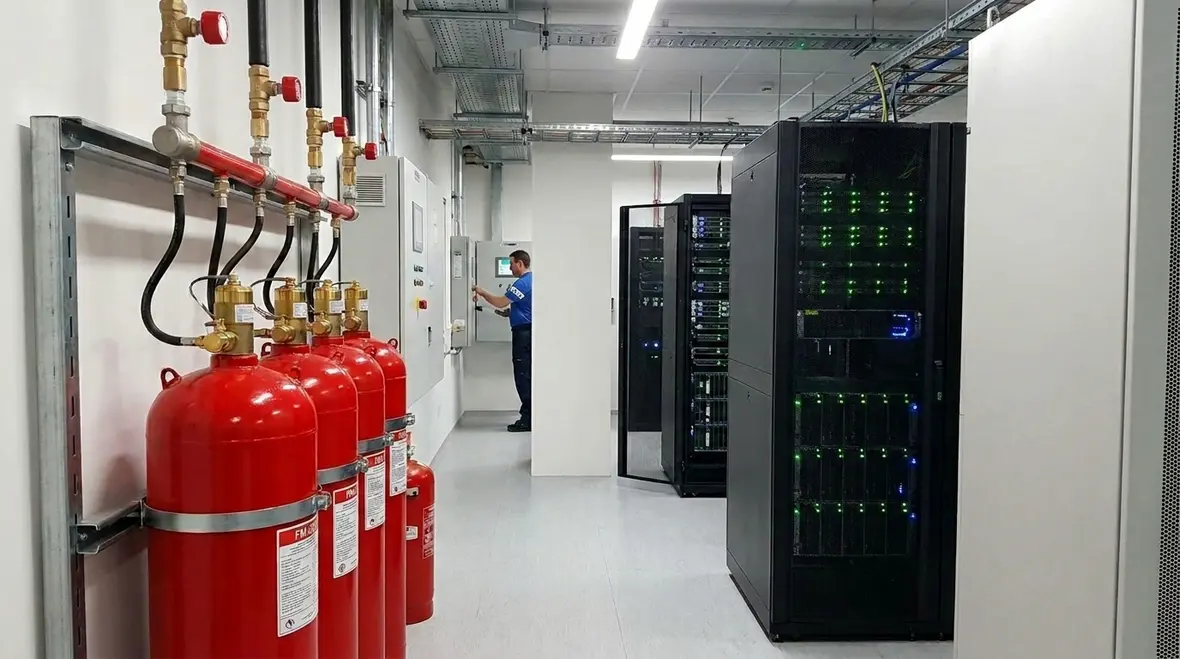
Fire fighting systems maintenance in Egypt: inspection requirements, Civil Defence compliance, and why it belongs under an integrated FM contract.
Fire fighting systems maintenance is the facility responsibility most often overlooked — until it is needed, when the cost of neglect becomes absolute. Fire suppression and detection systems sit quietly in a building for years, and because they are rarely used, they are easily forgotten. But a fire system that has not been maintained is a system that may fail at the one moment it matters. This guide sets out what fire fighting systems maintenance involves, the Egyptian Civil Defence compliance requirements, and why this critical duty belongs under an integrated facilities management contract rather than left to chance.
Why Fire Systems Get Overlooked
The paradox of fire protection is that its reliability is invisible until the moment of failure. A pump that has not been tested, a suppression system with depleted pressure, a detection panel with failed batteries — none of these announce themselves. The system appears present and therefore assumed functional.
This is exactly why fire fighting systems maintenance is neglected. Unlike HVAC, which fails visibly and disrupts daily operations, a fire system fails silently and is only discovered during an inspection — or, catastrophically, during a fire. The absence of daily consequence creates a false sense that the system needs no attention. It is a dangerous assumption, and a compliance breach.
What Fire Fighting Systems Maintenance Covers
A complete fire fighting systems maintenance programme covers detection, alarm, and suppression as an integrated whole:
- Detection systems — smoke and heat detectors tested and verified
- Alarm systems — audible and visual alarms confirmed functional across the building
- Fire suppression — sprinkler systems, pumps, and pressure verified and tested
- Fire pumps — the critical component, load-tested to confirm they start and perform on demand
- Extinguishers and hoses — inspected, serviced, and in date
- Control panels and batteries — verified, with backup power confirmed
The most critical element is fire suppression inspection and pump testing. A fire pump that fails to start on demand renders the entire suppression system useless — and an untested pump is a pump whose reliability is unknown.
What Are the Civil Defence Compliance Requirements?
In Egypt, fire safety falls under Civil Defence compliance. Commercial buildings are required to maintain their fire protection systems and to demonstrate that maintenance through inspection and documentation. This is not optional, and it is not a formality — it is a legal obligation with enforcement consequences.
The practical requirements for the facility owner are:
- Systems maintained to the required standard and kept operational
- Regular inspection and testing carried out and documented
- Records maintained as evidence of compliance
- Prompt correction of any deficiency identified
Civil Defence compliance is demonstrated through documented maintenance — the same evidentiary discipline that runs through all regulated building systems, as set out in our MEP systems management guide. A building that cannot evidence its fire-system maintenance cannot demonstrate compliance, regardless of the system's actual condition.
Who Is Responsible for Fire System Maintenance?
The responsibility rests with the building owner or operator — and this is precisely where the gap opens. Fire systems are specialist, easily overlooked, and outside most operators' core expertise. Left to internal management or an occasional standalone contractor, fire alarm maintenance and suppression testing are the tasks most likely to slip.
This is the strongest argument for placing fire fighting systems maintenance under an integrated facilities management contract. Within an integrated model, fire systems are managed on a defined schedule alongside the building's other critical systems, with documentation maintained as standard — removing the risk that the most consequential system in the building is the one that gets forgotten.
Why Fire Systems Belong Under an Integrated FM Contract
Fire protection interacts with the building's electrical and water systems, and its maintenance requires the same scheduling discipline and documentation as every other critical system. Managing it in isolation — or not at all — creates exactly the gap that leads to non-compliance and, in the worst case, system failure during a fire.
Under an integrated FM contract, fire fighting systems maintenance is scheduled, executed, and documented alongside electrical, mechanical, and plumbing maintenance, with one partner accountable for the whole. The most critical system in the building is then managed with the same discipline as the rest — not left as the responsibility no one owns.
What Must Fire System Documentation Include?
For fire fighting systems maintenance, documentation is not a formality — it is how Civil Defence compliance is demonstrated. A system can be in perfect condition, but without records, its compliance cannot be proven. And in fire safety, unproven compliance is treated as non-compliance.
Complete fire system documentation must include:
- Inspection records — what was checked, when, and by whom
- Test results — the outcomes of alarm, detection, and suppression testing, including fire-pump load tests
- Findings and deficiencies — any issues identified during inspection
- Corrective actions — how deficiencies were resolved, and when
- Certification — evidence that the systems meet the required standard
This documentation is the record that demonstrates compliance to Civil Defence and provides the operator with proof that the building's fire protection is maintained and functional. It is the same evidentiary discipline required across all regulated building systems, as set out in our MEP systems management guide. A programme that maintains but does not document leaves the operator exposed at exactly the moment — an inspection or an incident — when the records are needed most.
Why Is Deferred Fire Maintenance a False Economy?
Fire fighting systems maintenance is one of the easiest costs to defer, precisely because the system's failure is invisible until it matters. But deferring it is a false economy of the most dangerous kind.
The saving from skipping a fire-system service is small and immediate. The cost of that decision is potentially catastrophic and deferred: a compliance breach that surfaces at inspection, an enforcement consequence, or — in the worst case — a suppression system that fails during an actual fire, when its failure is measured in lives and total loss rather than money. There is no maintenance decision in a building where the gap between the saving and the potential cost is wider.
This asymmetry is why fire suppression inspection and fire alarm maintenance should never be the line that gets cut under budget pressure. The rational response is to remove the decision from discretionary budgeting altogether by placing fire fighting systems maintenance under a defined programme, scheduled and documented as standard — so that the most consequential system in the building is never the one quietly deferred.
Common Questions About Fire System Maintenance
How often must fire fighting systems be inspected in Egypt?
Fire and life-safety systems must be maintained and tested to Egyptian Civil Defence requirements, with inspection and testing documented and never deferred. The exact frequency follows the system and regulatory requirement, but the obligation to maintain, test, and document is continuous and legally enforceable.Why is fire system maintenance so often overlooked?
Because a fire system's reliability is invisible until the moment of failure. Unlike HVAC, which fails visibly and disrupts daily operations, a fire system fails silently and is only discovered during an inspection — or, catastrophically, during a fire. The absence of daily consequence creates a false sense that it needs no attention.Who is responsible for fire system maintenance?
The building owner or operator. Because fire systems are specialist and easily overlooked, they are the tasks most likely to slip under internal management. Placing them under an integrated FM contract ensures the most consequential system in the building is scheduled, tested, and documented as standard.The Integrated Approach
Ayadi Integrated Services delivers fire fighting systems maintenance across Egypt as part of an integrated facilities management model — detection, alarm, and suppression maintained and tested to Civil Defence compliance requirements, documented as standard, and managed alongside the building's other critical systems. Placing fire protection under one accountable contract ensures the system most easily overlooked is the one most reliably maintained. As part of AMD Holding, Ayadi brings this discipline to enterprise clients where fire safety is a legal and operational imperative. To discuss fire fighting systems maintenance for your building, request a service assessment.

